
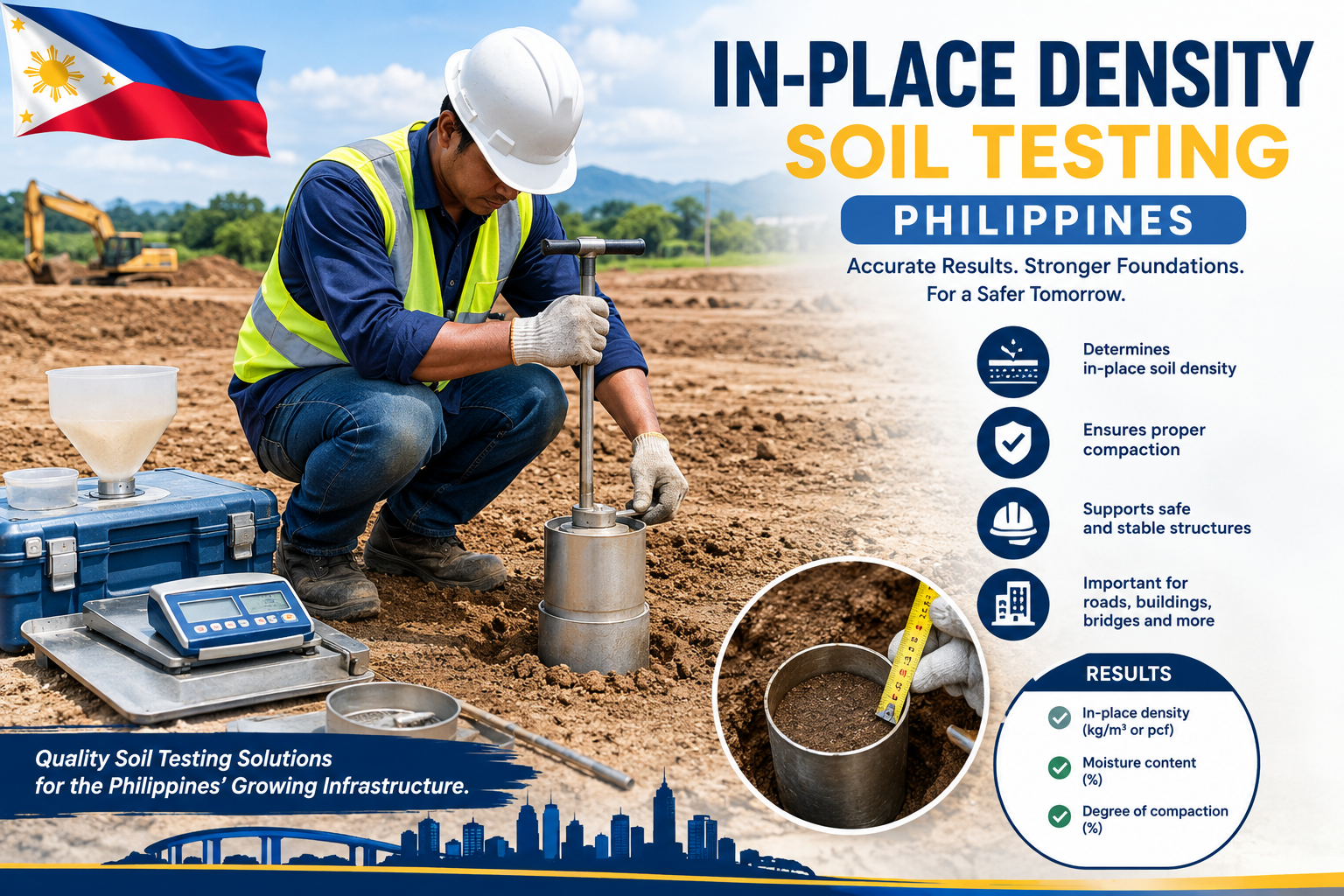
Understanding In-Place Soil Density
In-place density soil Philippines testing is an important field quality-control procedure used to determine how densely soil has been compacted at an actual construction site. Soil density can influence the stability, strength, settlement behavior, and long-term performance of areas prepared for buildings, roads, foundations, pavements, embankments, and other infrastructure. While laboratory testing can establish how a particular soil behaves under controlled compaction conditions, field density testing provides information about what has actually been achieved during construction. This distinction is important because site conditions are rarely identical to laboratory conditions. Factors such as moisture, compaction equipment, layer thickness, soil type, weather, and operator technique can influence the final density achieved in the field. A properly performed field density test gives engineers and construction teams measurable information that can be compared with the applicable project requirements. For Philippine construction projects, understanding the purpose and process of in-place density testing can help support better earthwork quality control and more reliable project documentation.
Why Density Testing Is Important for Construction Projects
Compacted soil is frequently used as part of the foundation or support system for many types of construction. If soil is not compacted adequately, the material may contain excessive voids that can contribute to settlement or deformation under future loading. These problems may affect pavement surfaces, slabs, foundations, walkways, parking areas, and other constructed features. Density testing provides a way to evaluate whether compacted soil has reached the level required by the project’s specifications. Instead of relying solely on visual inspection or the number of passes made by a roller, field testing provides measurable evidence of the soil’s condition. This can be particularly valuable on large projects where many layers of fill are placed over extended periods. Proper documentation also gives project teams a record that can be reviewed during quality-control inspections. By incorporating In-place density soil Philippines testing into an appropriate testing program, construction teams can identify potential compaction issues before subsequent layers conceal the affected material.
Soil Compaction and Its Effect on Density
Compaction involves applying mechanical energy to soil to reduce air spaces and bring soil particles closer together. Different types of equipment can be used depending on the material and construction requirements, including vibratory rollers, smooth-drum rollers, pneumatic rollers, plate compactors, and rammers. The effectiveness of compaction depends partly on the moisture condition of the soil at the time of treatment. Soil that is too dry may not compact efficiently, while excessive moisture can also interfere with achieving the desired dry density. Laboratory compaction testing can establish a moisture-density relationship that helps identify maximum dry density and an associated optimum moisture content under a specified compaction effort. ASTM D698 and ASTM D1557 are examples of laboratory procedures used to determine compaction characteristics under different levels of compactive effort. The field density measurement can then be compared with the applicable laboratory value when the project requires a percentage-compaction evaluation. This relationship between field testing and laboratory testing makes density control an important part of systematic earthwork quality management.
How In-Place Density Testing Works
The basic purpose of an in-place density test is to determine the mass of soil occupying a known volume at a selected field location. The specific process depends on the testing method required by the project. With a sand-cone or sand-replacement procedure, a small test hole is carefully created in the compacted layer and the removed soil is collected for weighing and moisture analysis. A calibrated material is then used to determine the volume of the excavated hole. Once the soil mass and test-hole volume are known, the field density can be calculated. Moisture-content information can then be used to determine dry density when required. DPWH materials-testing documentation references Field Density Testing procedures, including AASHTO T 191 for applicable soil and aggregate testing. The accuracy of the result depends on careful field preparation, proper equipment use, accurate measurements, appropriate calibration, and correct calculations.
The Role of Laboratory Compaction Testing
Laboratory compaction testing provides a controlled reference that can be used when evaluating field compaction. During laboratory testing, a soil sample is compacted at different moisture contents using a specified compactive effort. The resulting measurements can be used to develop a moisture-density relationship. From this relationship, the maximum dry density and corresponding optimum moisture content can be established for the tested material and procedure. ASTM D698 covers laboratory compaction characteristics using standard effort, while ASTM D1557 covers modified-effort compaction. The chosen laboratory procedure should be consistent with the requirements of the project specification and the intended application. Field density results can then be compared with the applicable laboratory maximum dry density when determining the percentage of compaction. This process provides engineers and quality-control personnel with a systematic method for evaluating whether field operations are achieving the required level of soil densification.
Common Field Density Testing Methods
Several methods can be used to measure soil density in the field, with the appropriate choice depending on the project and applicable specifications. The sand-cone method is a traditional field procedure that determines the volume of a test hole using calibrated sand or another specified material. It can provide useful measurements when performed correctly and under suitable field conditions. Nuclear density gauges can provide rapid measurements of density and moisture, although their use involves specialized equipment, trained personnel, and applicable regulatory and project requirements. Other field techniques may be appropriate for particular soil types, aggregate materials, or construction situations. The selected method should not be based solely on convenience or speed. Engineers and testing personnel should consider the material, required accuracy, project specification, available equipment, and recognized testing standard. Using the correct method helps ensure that field measurements provide meaningful information for construction quality control.
Where In-Place Density Testing Is Used
In-place density soil Philippines testing can be applied across a wide range of construction activities. Road construction is one major area where field density measurements can be used to evaluate compacted earthwork and related layers. Building projects may require testing of compacted fill beneath slabs, foundations, access areas, or other prepared surfaces. Utility projects can also involve density testing of backfill placed around trenches and underground infrastructure. Embankments and large earthwork projects may require repeated testing as soil is placed and compacted in successive layers. Parking areas, site development projects, drainage structures, and other civil works can also involve engineered fill that requires compaction control. The exact testing requirements depend on the project documents, material specifications, and governing standards. Because applications differ, project teams should establish the appropriate testing plan before fieldwork begins rather than assuming that the same procedure applies to every project.
Factors That Influence Field Density
Field density results can be affected by many conditions that occur before, during, and after compaction. Soil classification is important because different materials respond differently to mechanical compaction. Moisture content can have a significant effect on how efficiently soil particles can be rearranged. Lift thickness also matters because compacting a layer that is too thick can make it difficult for equipment to deliver sufficient energy throughout the material. The type and condition of compaction equipment can influence the density achieved after each pass. Weather conditions, particularly rainfall and prolonged exposure to moisture, can also alter the condition of soil at the jobsite. Testing technique, equipment calibration, sample handling, and calculation procedures can affect the reliability of the final measurement. Recognizing these variables allows project teams to investigate unusual results more effectively and make appropriate adjustments to construction procedures.
Reading an In-Place Density Test Report
A field density report provides a documented record of the testing performed at a specific location. Typical information can include the project name, test date, test location, material description, layer information, testing method, moisture content, wet density, dry density, and laboratory reference data. The report may also include the calculated percentage of compaction when this is required by the project. Understanding these values is important because a numerical density result cannot be evaluated properly without knowing the material and applicable specification. For example, the required compaction percentage can vary depending on the type of construction work and the governing project documents. A field density report should therefore be reviewed together with the relevant laboratory test and project requirements. Accurate test-point identification is also essential because engineers need to know exactly where the reported measurement was obtained. Well-organized reports can make it easier to track construction quality and identify locations requiring additional work.
What Causes Low Field Density Results?
A low density measurement can occur for several reasons, and identifying the underlying cause is important before corrective action is selected. The soil may have been placed with an unsuitable moisture content, making it difficult to achieve the desired density. The compacted layer may also have been placed too thick for the available equipment to effectively densify the entire depth. Insufficient roller passes, inappropriate equipment selection, or inconsistent operating procedures can contribute to lower-than-required density. Material changes can also influence field performance, particularly if the soil being compacted differs significantly from the material used for laboratory testing. Testing errors should also be considered when a result appears unusual or inconsistent with nearby measurements. After the potential cause has been evaluated, the responsible project team may determine whether additional compaction, moisture conditioning, material adjustment, or retesting is appropriate. Corrective work should always follow the applicable project specifications and engineering direction.
The Importance of Testing Different Construction Layers
Earthwork is commonly completed in layers rather than placing the entire required thickness of soil at once. Each layer must be properly placed and compacted before the next layer is added. Field density testing can help verify individual layers before they become inaccessible beneath additional material. Testing only the surface of a completed fill area may not provide information about the condition of deeper layers. For large projects, systematic testing at appropriate locations can provide better quality-control coverage. Test locations should be documented carefully so that results can be associated with specific construction stages and areas. If recurring low-density results appear in a particular layer or zone, the construction team can investigate whether the problem relates to material, moisture, equipment, or work procedures. Layer-by-layer quality control can therefore help prevent small compaction issues from becoming more difficult and expensive to address later.
Selecting a Reliable Soil Density Testing Service
When arranging In-place density soil Philippines testing, project owners and contractors should evaluate the capabilities of the testing provider. The provider should have appropriate equipment and personnel who understand the selected testing procedure. It is useful to ask which standard will be followed and how test results will be documented. The testing team should also be able to coordinate with site personnel regarding access, test locations, construction layers, and required laboratory information. Clear reporting is important because field results may need to be reviewed by engineers, consultants, contractors, inspectors, or project owners. Experience with similar soil and construction conditions can also be beneficial when unusual field conditions arise. Choosing a qualified testing provider can help project teams obtain consistent measurements and documentation that supports their construction quality-control process.
Planning the Cost and Frequency of Testing
The cost of field density testing depends on several project-specific factors. The number of test points, travel requirements, site accessibility, testing method, project size, reporting needs, and turnaround expectations can all influence the overall cost. A small construction site may require only a limited number of measurements, while a major infrastructure project can require numerous tests distributed across different locations and layers. Testing frequency should be established using the applicable project specification rather than choosing a frequency solely according to budget. Certain DPWH quality-assurance requirements establish testing frequencies for specific materials and work activities, demonstrating that requirements can vary according to the type of construction. Project teams should review their technical specifications before scheduling testing so that the testing provider understands the required scope. Advance coordination can also reduce delays by ensuring that test areas are ready and laboratory reference information is available. A well-planned testing schedule can make quality control more efficient while supporting the construction timeline.
Preparing for an In-Place Density Test
Proper preparation can make field density testing more efficient and reduce avoidable delays. Before the testing team arrives, the contractor should identify the material layer that needs to be tested and confirm that the area is ready for measurement. The applicable laboratory compaction information should be available when field results need to be compared with maximum dry density. Site personnel should also provide clear information about the test location, construction layer, and relevant project specifications. The testing area should be accessible and safe for technicians and equipment. If a particular testing method is required, the site team should avoid performing additional work that could disturb the designated test location before measurement is completed. Documentation should be maintained throughout the process so that each result can be traced to its specific location and construction stage. Good coordination between the contractor, engineer, and testing provider helps create a smoother field-testing process.
Frequently Asked Questions About In-Place Density Soil Philippines
What does in-place density mean?
In-place density refers to the density of soil as it exists within a specific location in the field after placement and compaction. It is different from a laboratory density measurement because the material is evaluated under actual site conditions. Field density can be expressed using measurements of mass and volume. Moisture content is commonly considered when determining dry density. The resulting value can be compared with an applicable laboratory reference when required by the project. This makes field density testing useful for construction quality control. The exact interpretation depends on the test procedure and project specification.
Why is in-place density testing needed?
In-place density testing helps determine whether compacted soil has achieved the required density specified for a construction activity. Visual inspection cannot reliably reveal the actual density of a soil layer. A field test provides numerical information that can be recorded and evaluated. This information may help identify areas requiring additional compaction before construction continues. Testing can also provide documentation for project quality-control records. The importance of testing increases when soil is being used to support structures, pavements, embankments, or other constructed features. The applicable project specification should determine the required testing scope.
What is the difference between field density and maximum dry density?
Field density is measured from soil at the construction site, while maximum dry density is generally established through a laboratory compaction procedure. Maximum dry density represents the highest dry density achieved under the specified laboratory conditions and compactive effort. Field dry density can be compared with that laboratory value when the project requires a percentage-compaction calculation. The laboratory method used to establish the reference value is therefore important. ASTM D698 and ASTM D1557 represent different laboratory compaction procedures with different compactive efforts. Project documents should identify which procedure and reference value apply to the work. Comparing the correct field and laboratory values is essential for meaningful quality control.
Is the sand-cone method suitable for soil testing?
The sand-cone or sand-replacement method is a recognized approach for determining the volume of a field excavation and calculating in-place soil density. It can be suitable when the material and project conditions are appropriate for the procedure. The test requires careful excavation, collection of the removed soil, calibrated equipment, and accurate measurements. Moisture content is also determined when dry density is required. AASHTO T 191 is referenced for field density testing in applicable DPWH quality-testing documentation. The project specification should determine whether this method is required or acceptable. Properly trained testing personnel should perform the procedure to help ensure reliable results.
How does moisture affect soil density?
Moisture has an important relationship with soil compaction. A certain amount of water can help soil particles move into a denser arrangement during mechanical compaction. If the soil is excessively dry or excessively wet, achieving the desired dry density may become more difficult. Laboratory compaction testing can establish a moisture-density relationship for a particular material and compactive effort. This information can help construction teams understand the moisture condition associated with the laboratory maximum dry density. Field moisture measurements provide additional information when evaluating actual construction conditions. Proper moisture control can therefore be an important part of achieving consistent compaction.
What should happen after a low-density test result?
A low-density result should be reviewed in relation to the applicable project requirements and field conditions. The team may examine moisture content, lift thickness, compaction equipment, number of passes, soil type, and testing information. If additional compaction can address the issue, the affected layer may be reworked according to the project requirements. In other circumstances, material adjustment or replacement may be considered. Retesting can be used to verify the condition after corrective work. The responsible engineer or quality-control team should determine the appropriate corrective procedure. Proper documentation of both the original and follow-up testing can help maintain a clear project record.
How frequently should field density tests be performed?
Testing frequency depends on the project, material, work item, and governing specification. There is no single frequency that applies to every construction site. Some infrastructure specifications establish minimum frequencies for particular materials or construction activities. The size and complexity of a project may also influence the number and distribution of test locations. Engineers and quality-control personnel should review the applicable requirements before construction begins. Testing should generally be coordinated with the placement of individual compacted layers when layer verification is required. A planned testing program can help prevent delays and reduce the possibility of covering unverified work.
Who should perform an in-place density soil test?
Field density testing should be performed by personnel who are qualified and familiar with the applicable testing procedure. The testing provider should have suitable equipment and understand the relevant measurement and calculation requirements. Proper documentation is also important because the results may become part of the project’s quality-control records. Project teams may need to verify the provider’s experience, equipment, procedures, and reporting capabilities before engaging their services. The selected provider should also be able to coordinate effectively with the project engineer and contractor. Following recognized procedures helps improve the consistency and usefulness of field measurements. For significant construction projects, testing arrangements should be established early rather than waiting until earthwork is already underway.
Takeaway
In-place density soil Philippines testing is a valuable component of construction quality control because it provides measurable information about the density achieved in compacted soil at the actual jobsite. It helps connect laboratory compaction data with real field conditions and gives engineers and contractors a basis for evaluating completed earthwork. The reliability of a field density result depends on the soil, moisture condition, compaction process, testing equipment, selected method, and accuracy of field measurements. Sand-replacement procedures and other recognized field methods can be used when they are appropriate for the project and permitted by its specifications. Proper testing can help identify insufficient compaction before additional construction work covers the affected layer. Effective planning also requires coordination among contractors, engineers, laboratory personnel, quality-control teams, and field testing providers. By using appropriate standards, accurate documentation, and a systematic testing program, construction teams can make better-informed decisions about compacted soil and support the quality and durability of Philippine construction projects.