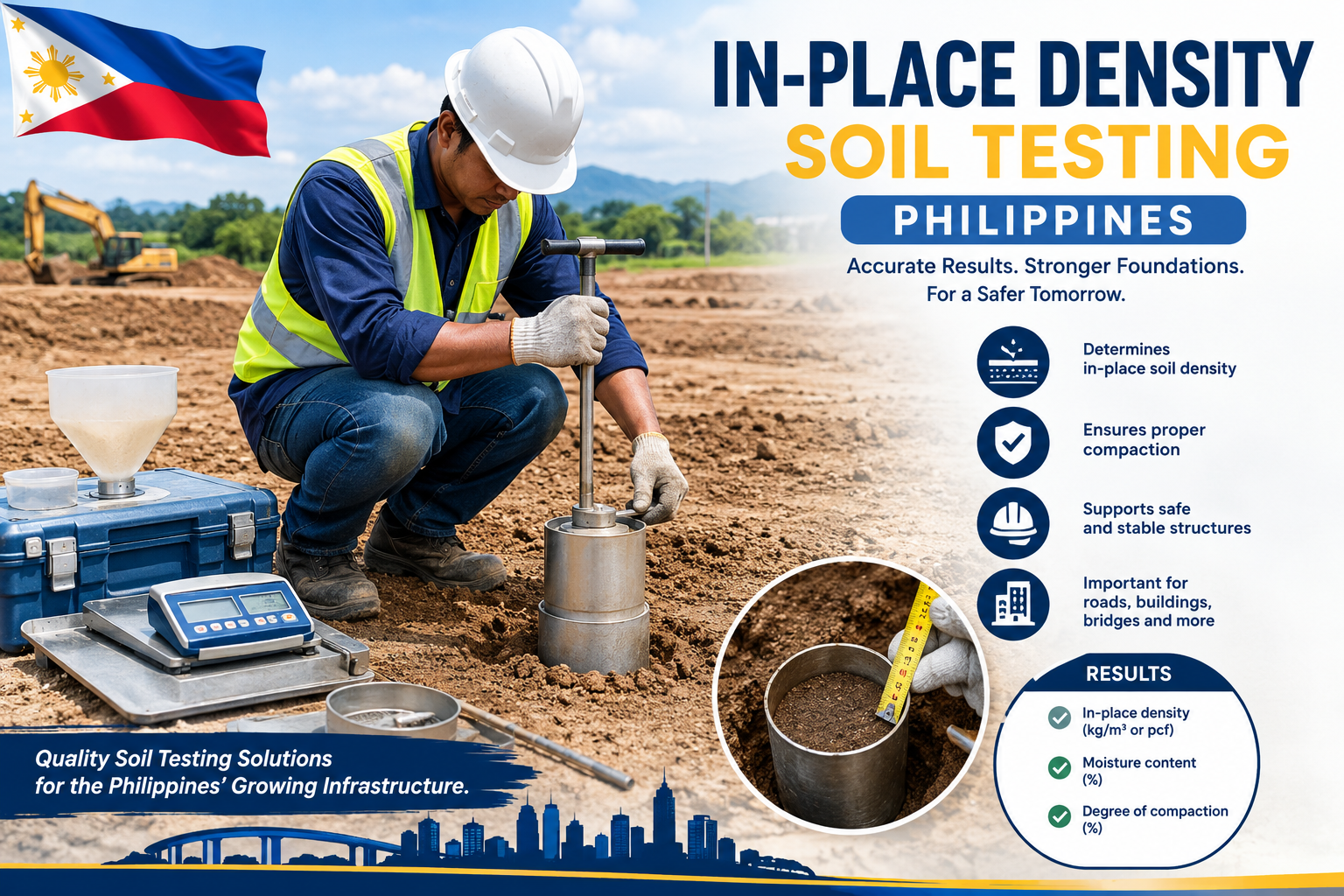

Soil Testing plays a critical role in every construction project because the ground beneath a structure determines its long-term stability. Soil Testing helps engineers understand whether a site can support the intended load, how much settlement may occur, and what type of foundation system is suitable. Without proper Soil Testing, construction projects face higher risks of cracking, uneven settlement, and structural failure.
Soil Testing also supports planning decisions during early design stages. Engineers rely on Soil Testing results to decide whether shallow foundations, deep foundations, or ground improvement methods are required. Every reliable construction plan begins with accurate Soil Testing results that reflect real site conditions.
Understanding Soil Testing in Geotechnical Engineering
Soil Testing refers to a set of procedures used to evaluate the physical and mechanical properties of soil. These properties determine how soil behaves under load and how it reacts to moisture changes over time. Soil Testing is essential for identifying soil strength, compressibility, density, and plasticity.
Soil Testing involves both field and laboratory methods. Field Soil Testing provides real-time data from actual site conditions, while laboratory Soil Testing delivers controlled analysis using calibrated equipment. Together, these methods create a complete profile of soil behavior that supports engineering design and construction safety.
Soil Testing also ensures compliance with engineering standards such as ASTM and AASHTO. These standards guide how Soil Testing is conducted and how results are interpreted for construction use.
Importance of Soil Testing Before Construction Begins
Soil Testing is essential before any structural work begins because soil conditions vary significantly from one location to another. A site that appears stable on the surface may contain weak layers beneath. Soil Testing reveals these hidden conditions early, helping engineers avoid costly mistakes.
Soil Testing helps prevent uneven settlement, which occurs when different parts of a structure sink at different rates. This condition often leads to cracks in walls, floor deformation, and long-term structural damage. Proper Soil Testing identifies soil layers that may cause this issue.
Soil Testing also reduces financial risk. Construction projects without Soil Testing often face unexpected repairs, redesigns, or delays. Early Soil Testing provides accurate data that improves decision-making and reduces uncertainty.
Key Properties Measured in Soil Testing
Soil Testing evaluates several engineering properties that directly affect construction safety and design. These include:
Soil strength, which determines how much load the ground can support without failure. Soil Testing measures this property to guide foundation design.
Moisture content, which affects soil stability and compaction behavior. Soil Testing identifies how water influences soil performance.
Soil density, which reflects how compact the soil is. Soil Testing helps determine whether compaction work is required before construction.
Plasticity, which describes how soil changes shape under stress. Soil Testing evaluates plasticity to classify soil behavior under different conditions.
Particle size distribution, which identifies the proportions of sand, silt, and clay. Soil Testing uses this data to classify soil types and predict performance.
Field Soil Testing Methods
Field Soil Testing is conducted directly at the construction site to evaluate real ground conditions. This type of Soil Testing provides immediate insight into soil behavior under natural conditions.
One of the most common field Soil Testing methods is the Standard Penetration Test (SPT), which follows ASTM D1586. This Soil Testing method measures soil resistance by driving a sampler into the ground. The results help engineers estimate soil strength and bearing capacity.
Field Soil Testing also includes pile testing, which evaluates the performance of foundation piles under load. This type of Soil Testing ensures that deep foundations meet design requirements and can safely support structural loads.
Field Soil Testing is essential because it captures actual site conditions that cannot be fully replicated in a laboratory.
Laboratory Soil Testing Methods
Laboratory Soil Testing provides controlled analysis of soil samples collected from the site. This type of Soil Testing ensures accurate measurement of soil properties using calibrated instruments.
Soil Testing in the laboratory includes grain size analysis based on ASTM D422. This test determines the distribution of soil particles and helps classify soil types.
Soil Testing also includes Atterberg limits testing under ASTM D4318. This procedure evaluates soil plasticity and consistency, which are important for understanding soil behavior under changing moisture conditions.
Compaction Soil Testing is another important method used in laboratories. It determines the optimal moisture content and maximum dry density of soil, which is essential for road construction and foundation preparation.
Laboratory Soil Testing ensures precision and consistency, which supports engineering calculations and design decisions.
ASTM and AASHTO Standards in Soil Testing
Soil Testing follows internationally recognized standards to ensure accuracy and consistency. ASTM and AASHTO standards define procedures for conducting Soil Testing and interpreting results.
ASTM D1586 governs the Standard Penetration Test used in field Soil Testing. ASTM D422 defines grain size analysis procedures used in laboratory Soil Testing. ASTM D4318 outlines methods for Atterberg limits Soil Testing.
These standards ensure that Soil Testing results are reliable and comparable across different projects and laboratories. Standardized Soil Testing also supports compliance with building codes and engineering requirements.
Role of Soil Testing in Foundation Design
Soil Testing directly influences foundation design because soil conditions determine how a structure transfers load to the ground. Engineers rely on Soil Testing results to select appropriate foundation types.
For soft or weak soils, Soil Testing may indicate the need for deep foundations such as piles. For stronger soils, shallow foundations may be sufficient. Soil Testing helps match foundation systems to site conditions.
Soil Testing also supports settlement analysis. Engineers use Soil Testing data to predict how much a structure will sink over time. This helps prevent uneven settlement and structural distortion.
Accurate Soil Testing improves safety, reduces material waste, and supports efficient foundation design.
Risks of Construction Without Soil Testing
Skipping Soil Testing increases the risk of serious construction problems. One major issue is unexpected settlement, where parts of a structure sink unevenly due to weak soil layers.
Without Soil Testing, foundation failure becomes more likely. Structures may develop cracks, tilt, or lose stability over time. Soil Testing helps prevent these conditions by identifying weak soil zones early.
Construction delays also occur when Soil Testing is not performed. Unexpected ground conditions often require redesign or reinforcement, which increases project time and cost.
Soil Testing reduces these risks by providing clear information before construction begins.
Soil Testing Services at Inch-On Materials Testing Laboratory
Inch-On Materials Testing Laboratory provides professional Soil Testing services for construction projects of different scales. The laboratory conducts both field and laboratory Soil Testing based on ASTM and AASHTO standards.
Field Soil Testing services include on-site evaluation of soil, concrete, and foundation piles. These Soil Testing procedures help verify ground conditions and foundation performance during construction.
Laboratory Soil Testing services include grain size analysis, plasticity testing, and compaction testing. Each Soil Testing process is performed using calibrated equipment to ensure accurate results.
Soil Testing at Inch-On supports engineers, contractors, and project owners by providing reliable data for design and construction decisions.
DPWH-BRS Accreditation and Soil Testing Quality
Soil Testing quality depends on proper accreditation and compliance with engineering standards. Inch-On Materials Testing Laboratory operates under DPWH-BRS accreditation, which confirms that its Soil Testing procedures meet regulatory requirements.
Accredited Soil Testing ensures that results are accepted for public and private construction projects. This level of Soil Testing quality control supports infrastructure safety and reliability.
Standard-based Soil Testing also ensures consistency across all test results. Engineers can trust Soil Testing data when it comes from accredited laboratories that follow strict procedures.
How Soil Testing Improves Construction Outcomes
Soil Testing improves construction outcomes by reducing uncertainty in foundation design. Accurate Soil Testing allows engineers to select proper foundation systems based on real ground conditions.
Soil Testing also helps control construction costs. Early identification of soil issues prevents redesign work and reduces material waste.
Soil Testing improves safety by ensuring that structures are built on stable ground. Reliable Soil Testing data reduces the risk of structural failure and long-term damage.
Projects that include Soil Testing tend to perform better in terms of durability and maintenance costs.
Soil Testing as the First Step to Safe Construction
Soil Testing remains one of the most important steps in construction planning. It provides essential data that guides foundation design, improves safety, and reduces project risks. Every structure depends on Soil Testing results that accurately reflect ground conditions.
With professional Soil Testing services from accredited laboratories like Inch-On Materials Testing Laboratory, construction projects gain the technical clarity needed for safe and stable development. Soil Testing ensures that every structure begins with a strong and reliable foundation.
Frequently Asked Questions About Soil Testing
What is Soil Testing in construction?
Soil Testing is the process of evaluating soil properties to determine its strength, stability, and suitability for supporting structures.
Why is Soil Testing important before building?
Soil Testing identifies ground conditions that affect foundation design and helps prevent structural problems such as settlement and cracking.
What standards are used in Soil Testing?
Soil Testing commonly follows ASTM and AASHTO standards, including ASTM D1586, ASTM D422, and ASTM D4318.
What is included in Soil Testing services?
Soil Testing services include field testing, laboratory testing, soil classification, compaction testing, and strength evaluation.
Who performs Soil Testing?
Soil Testing is performed by accredited geotechnical laboratories such as Inch-On Materials Testing Laboratory using trained technicians and engineers.
How long does Soil Testing take?
Soil Testing duration depends on project size and required tests, but it generally ranges from a few days to several weeks.
Can Soil Testing prevent foundation failure?
Yes, Soil Testing helps identify weak or unstable soil conditions early, reducing the risk of foundation failure and structural damage.